

Israel’s Security Establishment Assesses: The Global Antisemitic Campaign Is Engineered by State Actor /s
Officials assess a coordinated antisemitic campaign involving digital networks and possible shifts among key opinion figures, as Israel navigates renewed engagement with Qatar

In recent weeks, Israel’s security leadership has been increasingly focused on what it assesses to be a coordinated, global campaign of antisemitic and anti-Israeli activity.
Israel does not know with certainty who is behind the operation or operations, but it has become a central concern in Jerusalem. Israeli officials told me the issue requires close examination, not least because it appears to extend beyond any single country or arena. The anti-Israel and anti-Jewish rhetoric- across social media posts, as well as opinion figures - has surged in recent months, according to those Israeli experts. While some of this can be understood as fallout from the war’s end and the heavy human toll in Gaza, they say they have reached a disturbing conclusion, supported by intelligence: this represents a new, state-led endeavor. It goes well beyond the known phenomena on platforms such as TikTok. One substantive shift has been the move away from Gaza-focused attacks on Israel and Israelis toward more classic, generalized antisemitism.
Within the Israeli government, officials identify a broad, global, and primarily artificial effort - that is, engineered rather than organic - to intensify hostility and hatred toward Israelis and Zionist Jews. The emphasis is on the word artificial. Professional assessments presented to senior figures of the Defense apparatus have concluded that only state actors with large influence operations, backed by intelligence services, or alternatively a number of private influence firms hired by a state, are capable of executing the kind of coordinated and timed actions now appearing worldwide.

To the best of my knowledge, Israel does not yet know who is behind this coordinated campaign. The Israelis maintain it is not limited to “bots” or fake online accounts respones, but also includes the activation of opinion figures against Israel. The immediate suspects, according to Israeli assessments, are Qatar and/or other actors in the Arab world, Turkey, Russia, or even China.
At the same time, other Israeli officials caution against overstating the role of such a campaign. Much of the damage stems from far simpler causes: the war in Gaza has brought massive destruction and large-scale civilian deaths in Gaza. That reality is difficult to explain away, even without a state-driven influence operation.
Still, the concern is serious enough that Israel has raised the issue quietly with partners. Senior figures in the intelligence community have been tasked with preparing a fact-based evidentiary record tracing the full chain of connections- from possible state actors down to individual antisemitic posts, where feasible.
**
Against this backdrop, Israel’s broader relationship with Qatar come back into focus.
“It seems the Qataris have made a fundamental decision,” a senior, well-informed Israeli official told me, “to try to destroy relations between Israel and the Trump administration at their very foundation. They are in Jihad.”
In the Doha forum this week, Qatar’s prime minister gave an interview to Tucker Carlson (“Zionism is an enemy of Western civilization”). The prime minister spoke of the transfer of funds to Hamas over many years, with the support of Israeli governments, the Mossad and the Shin Bet - as well as administrations in Washington. Those remarks made headlines in Israel. But the truly troubling statement was as to Gaza’s reconstruction. Sheikh Mohammed bin Abdulrahman Al Thani said: “We are not the ones who are going to write the check to rebuild what others destroyed,” adding that “our payments will only go to help the Palestinian people if we see that the help coming to them is insufficient.” That is very far from what Qatar promised to do as to re-building Gaza.
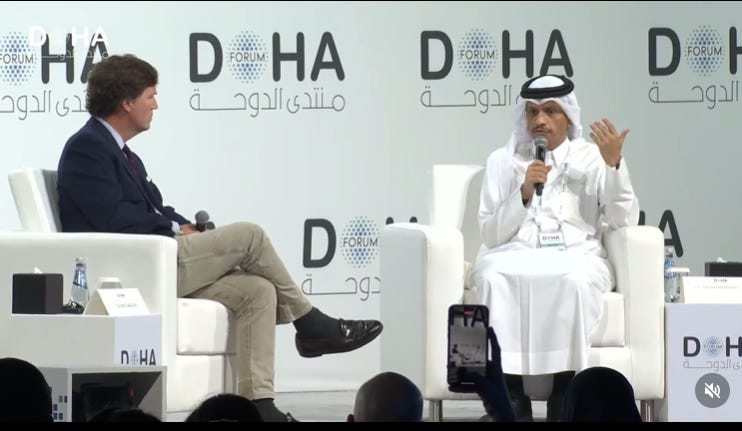
Earlier, the prime minister rejected the notion that a ceasefire was already in place in Gaza. “It’s not yet there,” he said. “What we have just done is a pause. We cannot consider it yet a ceasefire. A ceasefire cannot be completed unless there is a full withdrawal of the Israeli forces, which is not the case today.” Rhetorically, at least, this grants legitimacy to a renewal of Hamas attacks against IDF forces inside the Strip.
Later, a Qatari government spokesperson softened the prime minister’s remarks on reconstruction, clarifying that Qatar does not intend to fund Gaza’s reconstruction on its own, but would be willing to participate alongside other countries. It was an odd clarification — a 180-degree reversal. Perhaps someone received a phone call from Washington.
**
It was in this atmosphere that an unusual meeting took place on Sunday in New York, involving U.S. presidential envoy Steve Witkoff, Mossad director Dedi Barnea, and a senior Qatari official. My colleague Barak Ravid first reported on the meeting and its subject.
The background was the now-famous phone call from the White House between Prime Minister Netanyahu and Qatar’s prime minister, during which Netanyahu apologized for the failed Israeli strike in Doha in September 2025. As part of the arrangement, the Americans imposed a tripartite mechanism for “coordination” and “de-escalation” among the countries. This was the first such meeting.
What did the Israelis raise? Official sources declined to comment. Still, lets make an informed assessment of several likely issues.
One is Al Jazeera. More than a month ago, senior editors and management were replaced at the network. The hope was that this would dilute its aggressive editorial line against Israel - produced with Qatari state funding and broadcast throughout the Muslim world. It did not happen. Just this week, Israeli officials complained about obessive coverage of Syrian civilians calling for jihad against Israel, at a time when the two countries are attempting to reach a security arrangement. Al Jazeera’s coverage carries strategic weight for Israel’s regional standing.
Another issue is the presence of senior Hamas figures in Qatar. Doha now enjoys an official U.S. security umbrella, secured from President Trump following the Israeli strike. At the same time, it continues to host Hamas leaders, who effectively enjoy total immunity. This could turn Doha into an official safe haven for any terrorist targeting Israel worldwide.
Israeli ministers frequently state that Israel wants Hamas leaders expelled. That is stage one. Stage two, many politicians say openly, is their elimination, together with all those who planned October 7.
It is doubtful Doha will agree. In any case, the Qataris have their own list of demands. They are at the height of their golden age with Washington: a presidential commitment to defend them, FBI cooperation agreements signed this week, massive deals and investments in the United States, and - most importantly- chemistry with the President. They do not want this moment to be squandered or ruined by confrontation with Israel, and they do not underestimate Israel’s influence in the American capital.
According to one source (not from the Qatari administration but in close contact with them), the Qataris are “in panic” over the political backlash they are encountering across the U.S., and over what they see as the “staining” of their name. This strikes at the heart of Qatar’s long-standing strategy: playing on all fields -extending a hand to the West while simultaneously engaging Islamist actors and promoting Muslim Brotherhood themes.
Qatar has influence in Washington, but it knows that this influence does not rest on American public opinion. No member of Congress receives angry calls from voters demanding support for Qatar; many do receive such calls from Americans who strongly support the U.S.–Israel alliance. Still, Qatar has another, formidable asset: “They have more money than God,” as one senior Israeli put it to me.
**
Now, the question becomes unavoidable: what is Israel’s strategy toward Qatar now?
For two years, Israeli officials briefed -off the record - that the sole reason Jerusalem continued speaking with Doha after October 7 was the hostages. Now that all living hostages have returned, and all bodies except that of Ran Givli have been recovered, why are relations with Qatar effectively being renewed?
And more broadly: what is Israel’s strategic objective vis-à-vis a this country, emerging from the war strengthened, shielded from Israeli attack, with improved ties to Washington and a future role in Gaza’s reconstruction?
This question sharpens in light of the prevailing view within Israel’s security establishment toward Qatar. For years, Doha has been seen as the diplomatic arm of the Muslim Brotherhood. Qatar provided patronage and refuge to Sheikh Yusuf al-Qaradawi, long a central figure of the Muslim Brotherhood. He justified suicide attacks against Israelis and embraced Hamas leaders, while opposing ISIS violence and being regarded in parts of the Muslim world as relatively moderate.
Al Jazeera - Qatar’s major soft power project- gave Qaradawi a weekly program that cemented his religious authority and shaped a generation of Islamists. Dr. Majed Al-Ansari, spokesperson for Qatar’s Foreign Ministry and adviser to the prime minister. On May 12, 2021, he tweeted under the hashtag #Tel_Aviv_is_burning, praising “Palestine” for reminding the Islamic nation of “its glory and greatness,” and declaring that victory belongs to Allah alone. The fighting ended nine days later; in hindsight, Yahya Sinwar also viewed that confrontation as a major victory that paved the way to October 7.
This story was published by the Jewish Insider, this was only one inciting post among several. Qatar’s embassy in Washington declined to comment, and Al-Ansari later deleted his posts.
**
In Israel, public discourse has largely shifted to the investigation into Qatar and the alleged purchase of influence inside the prime minister’s office - a dramatic investigtion - as well as the funneling of money for years to Hamas from Qatar, authorized by mainly Netanyahu.
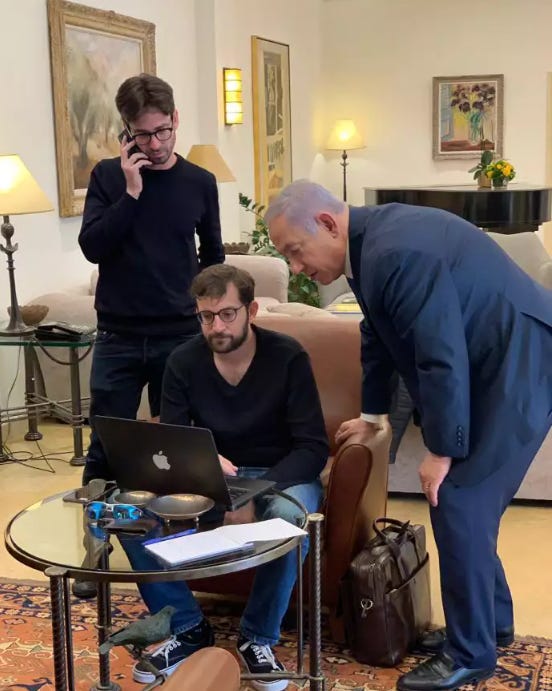
But this affair is only one element of a broader nexus. Another is Qatar’s role in facilitating the hostage deal and the end of the war in Gaza - one that security officials in Israel say was crucial. Indeed, why that result emerged only two years into the war remains disputed. The IDF argues Hamas was militarily cornered and Qatar intervened to save its proxy. Netanyahu’s allies argue that a failed assassination attempt against Hamas leaders in Doha placed decisive pressure on the emirate - leading to preassure on Hamas.
That airstrike occurred while a ceasefire proposal was already on the table and against the objections of the IDF and the Mossad chiefs. A fact remains: prime minister’s Netanyahu most aggressive moves against Qatar began only after investigations into his associates were launched.
If pressure on Qatar was decisive, the question follows naturally: why was such pressure avoided for most of the war?
The Shin Bet repeatedly sought to close Al Jazeera’s offices in Israel. Netanyahu blocked it until late in the war. Intelligence agencies pushed for expelling Hamas leaders or targeting them directly to pressure Qatar. Netanyahu, according to senior sources, prevented these steps.
Officials continue to argue that Qatar was preserved as a mediation channel precisely because of its influence over Hamas. “Because of its closeness to Hamas and the Muslim Brotherhood,” one cabinet member put it, “we needed them.” Now Israel is committed to working with Qatar on Gaza, even as Doha moves to anchor itself in a new regional Sunni axis alongside Turkey. “Just when I thought I was out, they pull me back in.”
The Qatar issue underscores a broader reality: despite enormous sacrifice and remarkable operational success by the IDF, Israel is emerging from the war without a coherent regional strategy - and therefore without a clear strategy toward Qatar.
Given Qatar’s persistent refusal to turn its back on radicalism - a choice it could still reverse, as many others in the region have done - Israel’s failure to isolate Doha points to deeper dilemmas. Above all, it reflects the erosion of the soft power of Netanyahu’s Jerusalem across much of the region.